Role
Design Engineer
Industry
Craft Tools · Creative Technology
Duration
4 months
Concord
A bedside device that tracks your heart rate, respiratory rate, and sleep without anything on your body.
Role
Design Engineer
Industry
Digital Health / Sleep Tech
Duration
5 months
Most people stop wearing their trackers.
Wearables are how most people track their health, and most people stop using them.
1 in 3
users quit within a year, and half within 18 months.
40%
of those who stopped tracking sleep said the device was uncomfortable to wear to bed.
40%
of those who never started said they don't want to wear something to sleep.
That gap matters most when something goes wrong. A resting heart rate only looks abnormal if there are months of normal to compare it to.
How might we capture the health data people want, over months and years, without asking them to wear, charge, or remember anything?
The interaction model: remove the daily opt-in.
Survey, 41 people
The research pointed to the daily opt-in as the failure point.
Interviews, 6 people
Health data is most useful in hindsight, and hindsight needs a continuous record. The signals that matter most (resting heart rate, heart rate variability, respiratory rate, sleep stages) are captured during sleep anyway.
Concord makes tracking the default. The device does the remembering.
Privacy was a UX decision: radar, not a camera.
We started with the data, not the form: how do you get heart rate and breathing rate accurately without putting anything on the body?
mmWave radar
Measures chest movement directly and never captures an image of anyone.
Thermal camera
Dropped, because we didn't need what it added.
Low-light and depth cameras
Out, since a camera in the bedroom is invasive.
PPG and motion
The stack wearables use.
The tradeoff is that the heartbeat is the hardest signal for radar. The movement is tiny and body motion corrupts it. We accepted that because the alternative was a device people stop using.
Testing in context showed placement was the real problem.
In our first test, our user wore their Whoop while the sensor tracked them at home, and the two datasets were close. The dropouts came in another user test when they drifted toward the edge of the sensing zone. That made placement the problem, not the sensor.
Testing showed the radar has to point at the chest at about a 45° angle, or sit on the same plane as it.

The onboarding experience became part of the design.
The experience hinged on one moment, getting the sensor aimed correctly, so I designed the setup around it, across the device and the app: one physical action per screen.
Beds and nightstands sit at different heights, so I explored ways to aim it: fixed or clipped to the wall or bed frame, and stands with adjustable angle, height, or both.
An adjustable stand creates its own problem: someone has to set it up. We designed a one-time onboarding flow to walk them through placement.
Sliding the device along the rails to adjust height.

Ways to aim it: fixed or clipped to the wall or bed frame, and stands with adjustable angle, height, or both.

A preview of the companion app's one-time setup: six screens, one physical action each, to get the sensor aimed correctly. The app is still in development.
Turning raw sensor data into meaning.
The dense, continuous streams of data are translated into plain-language takeaways that surface trends that a user could never notice on their own.
Example takeaways
“Your deep sleep dropped 40% on nights your CO₂ rose above 1,000 ppm — try cracking a window before bed.”
“Your deep sleep drops 30% when bedroom humidity exceeds 65%.”
The companion app, still in development.
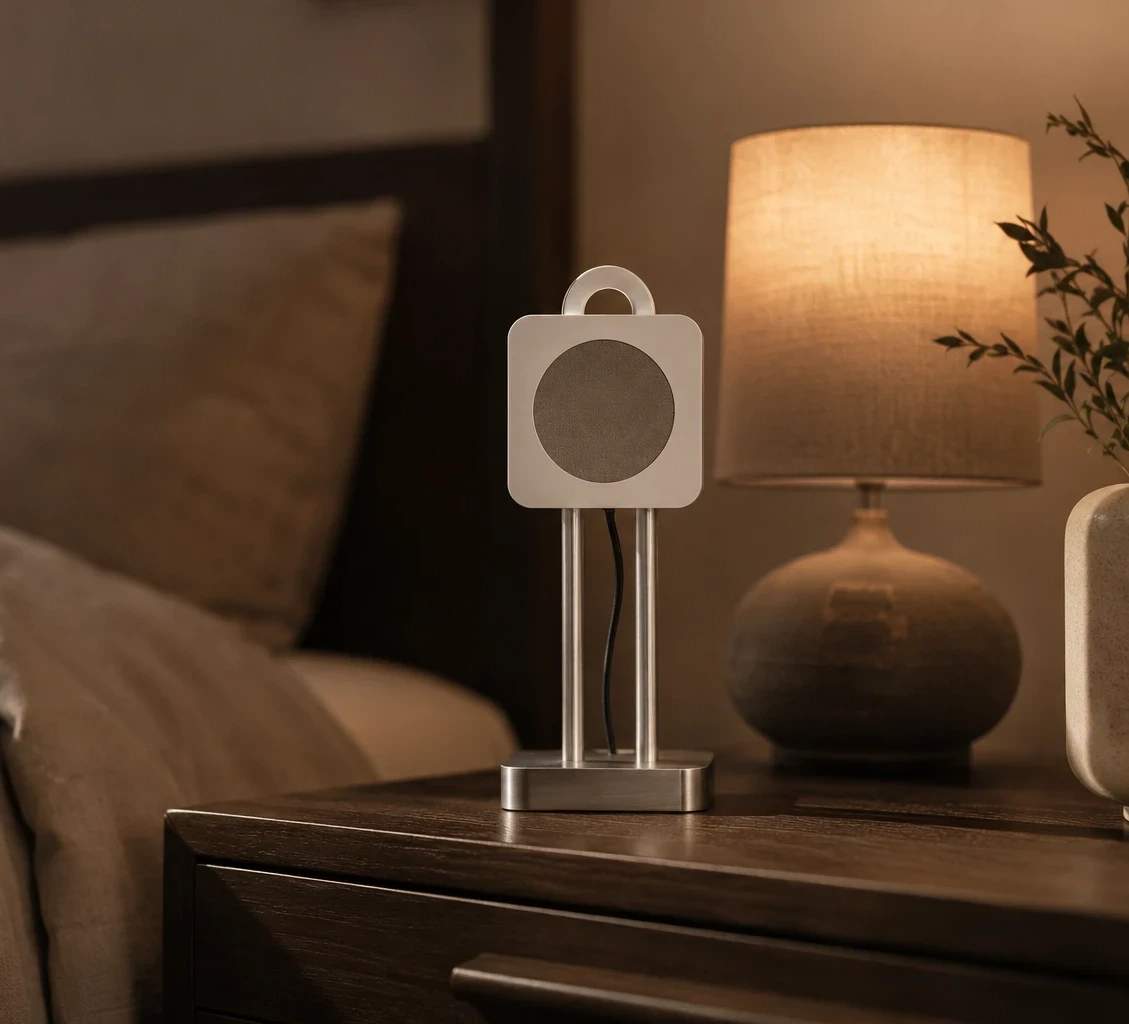
A face on sliding rods, built to sit on your bedside table.
The final form is a rounded-square face on two aluminium rods, with a loop handle. The face is fabric because the radar needs non-metallic material in front of the sensor, and it keeps the device from looking like medical equipment. It's meant to sit beside a lamp and a stack of books.

Early prototype.

Final prototype.

Form studies.
Next iteration.
Detachable housing
The center housing detaches from the rods, so it can mount on a headboard.
Detachable housing
The radar reads one person at a time. Two people in range corrupted our overnight tests.
Companion app
To be further built out.
Under the hood
Concord uses a 60 GHz millimeter-wave radar to detect chest movement as small as 0.3 mm. The slower signal is breathing and the faster one is the heartbeat. A BME680 sensor adds room temperature, humidity, pressure, and air quality. The companion app, still in development, is designed to turn the data into plain-language takeaways instead of raw charts.


Visitors at the RISD Grad Show exhibition interacting with Concord.